Dec 7, 2010
Xinpu Baliguo 新埔吧哩啯
From my point of view, Xinpu is a small and traditional township~ Here don’t have shopping centers and high buildings~ same as other small townships~ Xinpu facing the problem of aging population, most of the young people are moving to city for their career and education~ when you walk around at the township, you will see most of the pedestrian are old people.
Although Xinpu not lively as city but it has its own special attraction that I had mentioned at the first paragraph. Many tourists will travel to this little and traditional township because of the foods and historical spots. That’s why you will see a different picture between weekdays and weekends or holiday~ A lonely street during weekdays and a lively street during weekends and holidays~
Residents of Xinpu are hardworking and healthy, they wake up early to work and sleep early too~ I almost remain the same lifestyle when I staying here~ wake up and sleep early~ Hehe~ I’m very healthy for the moment~
Overall, Xinpu is a special township for me because I had stay here for almost 4 weeks~ will back to Malaysia after 2 weeks~ Not a long period but is enough for me to fill in a part of my memories~ No matter it is sweet or bitter~ ^.^
Interesting day~
Date: 7/12/2010
Location: Jiuqiong Lake
Today was a interesting day in Jiuqiong Lake~ There was two different groups came to visit Jiuqiong Lake~
Group 1: Jhongsan Elementary school
Group 2: Tourists from Guatemala
They came in different period, so I joined them to take some pictures for my writing ^.^
Student group
This is their school trip and totally has 3 buses~ ~ They came here to see something they can't see in the class room like real insects and plants~ The most important thing is have FUN~
Because of some reasons~ I just took some pictures when they are doing DIY and lunch~
Let’s have a look how cute they are~~~ ^.^

Some of the students

Their uniform so colorful~

DIY started~ Ingredients are soil, plant, flowerpot, and fertilize~

Their teacher teach them the steps~

They are so concentrate when planting~
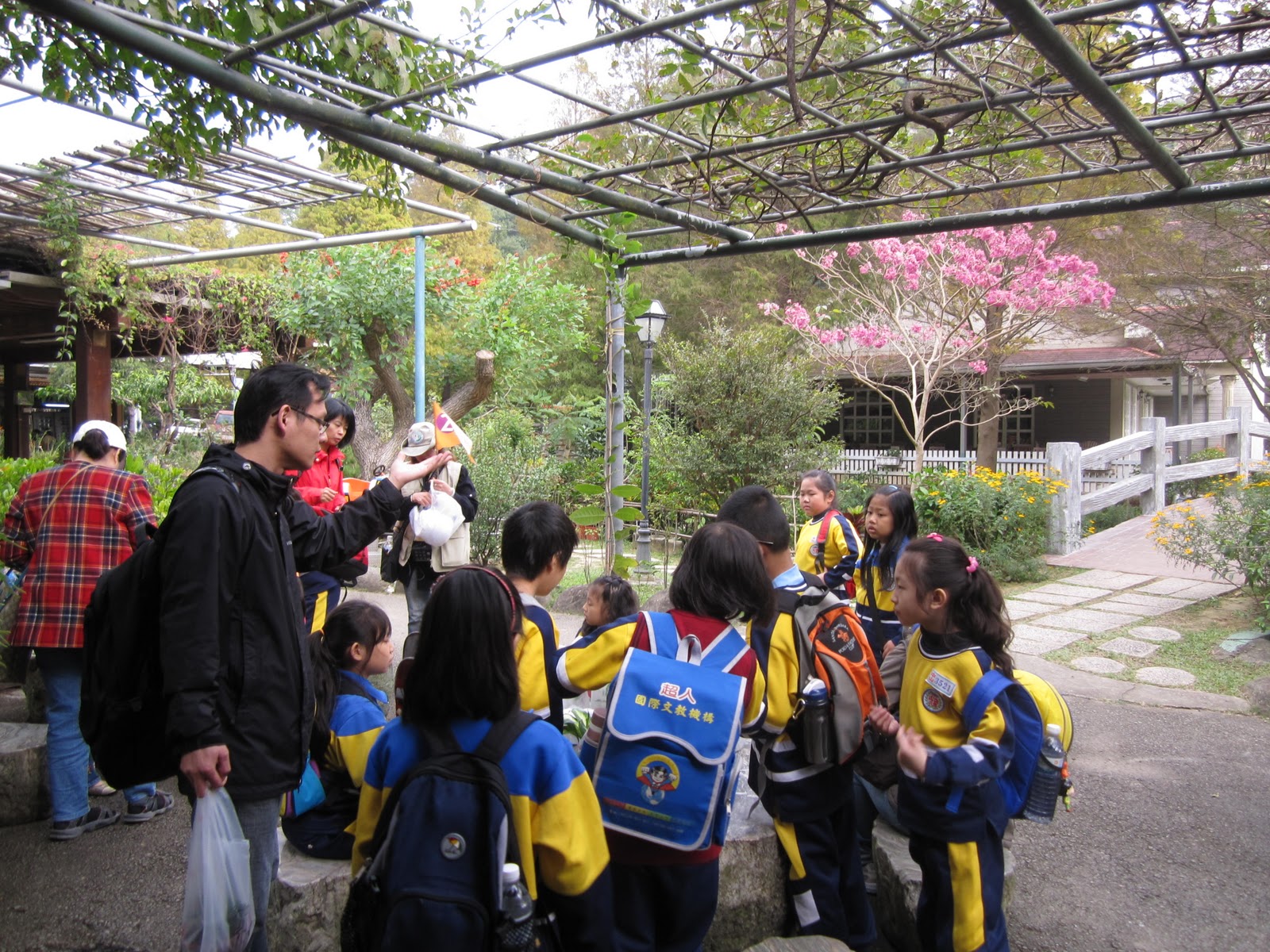
Finished planting~ Is time for lunch~

Finding their place~

Getting foods~ the lunch is fried mee, fried bantiao and gongwan soup~ They brought their own tableware (a good action that should learn by all of us)

After lunch, they have fun at the garden of Golden valley farm~

feeding fishes~
They are so cute!!! I want to back to my childhood days!!! No worries and innocent~ ^.^
Guatemala group
They came here sure for travel lah~ so I don’t explain so much jor~ When they came, I got it that almost all of them don’t know how to speak English~ Luckily they had translator to help them translate~
They had lunch at Liu’s stewed chicken restaurant when just arrived here~ They are surprising me because most of them know how to use chopstick although not so expert but good enough~ This is their 1st time had Hakka cuisine, according to some of them, they like it!!! :O


After had lunch, next station is Pi Tang Wo and Golden valley farm, Pi Tang Wo is the eco-park that I had mention at my previous article~ so I won’t repeat again~ :D
They look very interested because there has many plants that can’t grow at their country~


Mr Huang explain the park in Mandarin ~

The translator translated to Spanish ~

They walked around~

Explanation about Golden valley farm~

The famous fruits of Xinpu~
Last station~ Chen’s Farm, they DIY Hakka ground tea (擂茶) and mashu(麻薯)~
I’m interested too because this is my 1st time DIY Hakka ground tea and mashu~ The Hakka ground tea is different with Malaysia Hakka ground tea~ I will give further explaination when I free~ Haha~ Now move on to see the happy and excited expression of Guatemala tourist when they are doing Hakka ground tea and mashu~

Ingredients~ i'm not sure all of its, so din't mention at here~

Showed the steps to them~

They try by themselves~

These guys work hard XP

Doing Mashu~

Ready to serve~

prepared the Hakka ground tea~

Hakka ground tea~ taste nice~

Mashu~ Nice too~

She can speak English~

Take a picture before leave~
Gracias~ Thank you~谢谢~
This is Spanish i had learned today^.^
Dec 1, 2010
What Connie know about Jiuqiong Lake (the place she working)???
These are what Connie knows about Jiuqiong Lake before she comes~
Where is Jiuqiong Lake? Hsinzhu~
Where is the specific location? Don’t know~
How with its environment? Erm… as she know is beautiful~
What else she know about Jiuqiong Lake? Nothing ler~ XP
Aiyoyo~ That’s all you know??? Connie Chen realizes that she can’t do anything if she doesn’t know anything about Jiuqiong Lake. Apa boleh buat?
Never mind~ she has time to get more and more information because she will stay here for 6 weeks~ Haha~
The 1st thing she realizes is Jiuqiong Lake is much bigger than what she had imagined. She needs around 20 minutes to walk from the main entrance until the end of this place. This is the time taken to walk along main road, If want to visit each spot of Jiuqiong Lake…at least half day will be spent!!!
The 2nd thing is the location of Jiuqiong Lake~ She get know that Jiuqiong Lake located at Xinpu township and is under Jhaomen Recreation Agriculture District.
Jhaomen Recreation Agriculture District included two areas which are Jiuqiong Lake and Jianzhu Wo. This 300 hectares of valley region was formed by five hills, originally was Taokas people’s hunting area, this area developed by the Han Chinese afterwards. Their main activity is farming. Citrus and pears were their main crops. Jiuqiong Lake and Jianzhu Wo is simple and sincere Hakka tribe village.
Since 1990, Council of Agriculture Executive Yuan R.O.C., Soil and Water Conservation Bureau, Hsinchu County Government and Xinpu Township Office were coordinated with the rural development plan and depend on the strong spiritual and creativity of Hakka tribe, a beautiful and high quality farm and tourism place was formed. Jhaomen Recreation Agriculture District had elected as ten classic models of farming and fishing village at 1996.
In Hakka language, lake(湖) and Wo(窝)means the depression between the mountains, the wider depression called as lake(湖)and the narrow depression called as Wo(窝). Jiuqiong lake and Jianzhu Wo got a lots of Jiuqiong tree and Fargesia (is a genus of medium to small mountain clumping bamboos, they are known in Chinese as jian zhu (Chinese: 箭竹; pinyin: jiànzhú), meaning "arrow bamboo". That’s why the Hakka ancestor named these places as Jiuqiong Lake and Jianzhu Wo.
Jhaomen area is known for its lush greenness and serenity. Rolling hills with fruit trees of Hengshan pear (also known as oriental pear), grafted pear, honey tangerine, Haili tankan, and pomelo. The Hengshan pear and the Haili tankan are particularly popular in this area. Besides that, a special statement is use to describe Jhaomen which is ‘a family has a pond’. There are many others attraction, for example hiking trails, ponds, gardens, Southern Cypress (落羽松), and butterflies.
Wow~ Why suddenly Connie will know so much??? Haha~ that’s because she had read a book about Jhomen Recreation Agriculture District. So she translated the article to English, Maybe not so accurate but she hope people who read will understand and find out more through this article.
Connie~ don’t think this is enough oh~ Haha~
Subscribe to:
Posts (Atom)